
Clan MacGregor
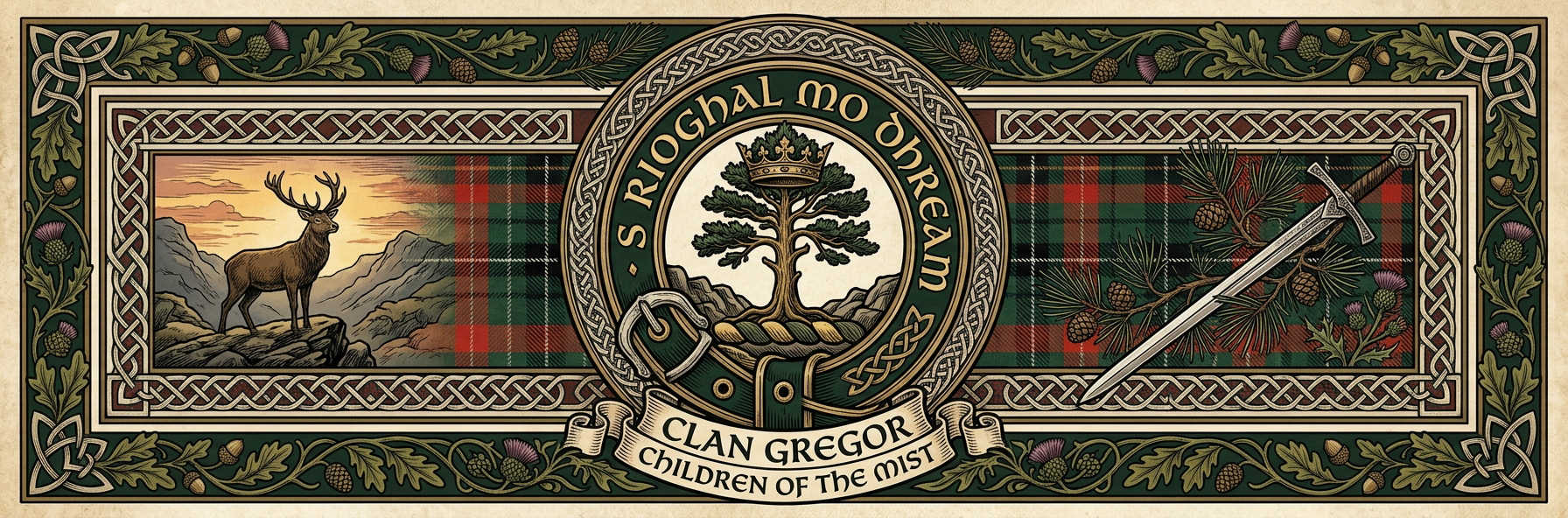
Table of Contents
The village takes its name from the Reverend Andrew McGregor, a Scottish-born Dutch Reformed Church minister who was recruited to South Africa in the early 1860s and went on to serve the Robertson congregation for forty years, from 1862 until his retirement in 1902. He also ministered to the nearby settlement of Lady Grey, and it was in his honor that the village was renamed McGregor in 1905–1906, once the confusion of sharing a name with another Lady Grey in the Eastern Cape had become too much for the postal service to bear.
The link to Clan Gregor itself is one of name rather than any documented family tree. Under Highland Scottish tradition, anyone bearing the MacGregor or McGregor surname — or one of its many septs — is considered part of the clan, whether or not a direct line back to its chiefs can be traced. No genealogical record ties Rev. McGregor to a specific branch of the clan’s chiefly line; the connection he carried into the Overberg was simply the name itself, and the shared heritage, motto and history that come with it. It is a link locals have sometimes lost sight of over the years, even as another descendant carried the name to fame in its own right: Rev. McGregor’s great-grandson was the noted South African jazz pianist and composer Chris McGregor.
Clan Gregor: A History of the MacGregors
Clan Gregor is one of the great Highland clans of Scotland, famous both for its claimed royal descent and for the two centuries it spent outlawed after a long and bitter power struggle with Clan Campbell. The clan traces its line back to a son of Kenneth MacAlpin, the first King of Scotland — a heritage proclaimed in its motto, ‘S Rioghal Mo Dhream, “Royal is my Race.”
Origins in the Mists of History
The clan is thought to have taken shape in Scotland during the 800s. According to the MacGregors’ own tradition, the name descends from Gregor, a son of King Kenneth MacAlpin — a claim lent some support by Y-chromosome studies, which show the clan’s hereditary genetic markers to be consistent with those of other families claiming descent from the early Dalriadic kings. A second, competing theory holds that the clan instead descends from Griogair, son of Dungal, a joint ruler of Alba in north-central Scotland between 879 and 889 — though the genetic evidence does not support this version of events.
War and Dispossession
In the 14th century, during the Wars of Scottish Independence, the MacGregors fought at the Battle of Bannockburn under their chief, Malcolm MacGregor. The clan’s first chief on secure historical footing is generally agreed to be Gregor “of the Golden Bridles,” succeeded before 1390 by his son, Iain Camm, “of the One Eye.”
The clan’s fortunes turned sharply when King Robert the Bruce granted much of its land — including the barony of Loch Awe — to Clan Campbell. Driven from these lands, the MacGregors fought the Campbells for decades before being dispossessed almost entirely, retreating ever deeper into the Highlands until they were largely confined to Glenstrae. Landless and increasingly desperate, many turned to rustling cattle and poaching deer to survive, and grew so skilled at it that other clans took to paying them simply to be left alone.
One notable episode from this period is the storming of Castle Grant, originally a stronghold of Clan Comyn, said to have been taken in the 14th century by a combined force of the Grants and MacGregors. Clan Grant tradition holds that the slain Comyn chief’s skull was kept afterward as a trophy and heirloom at Castle Grant — one account even describing it as hinged at the crown and used to store documents — with a warning that the clan would lose all its lands in Strathspey should the skull ever leave the family’s hands.
The “Children of the Mist”
The chiefship passed into disarray when Iain of Glenstrae died without a direct heir in 1519, giving the Campbells an opening to meddle in the succession and press their claim to what remained of MacGregor land. In 1560 they dispossessed Gregor Roy MacGregor, who fought the Campbells for ten years before being captured and killed. His son Alistair inherited the chiefship but could do little to halt the persecution that was by now the settled fate of the “Children of the Mist” — a name earned, it was said, for the clan’s knack of vanishing into the Highland fog.
The Earl of Argyll and his Campbell allies were tasked with hunting the scattered MacGregors down. At Bentoik, around sixty clansmen made a defiant stand against two hundred men of Clan Cameron, Clan MacNab and Clan Ranald under Robert Campbell, son of the Laird of Glenorchy. Duncan Aberach, one of the MacGregor chieftains, his son, and seven others were killed in the fighting; despite inflicting heavy losses on their pursuers, the MacGregors were eventually overwhelmed.
The clan also fought the English at the Battle of Pinkie Cleugh in 1547, and in 1558 was drawn into a violent feud with Clan MacLaren after killing eighteen MacLaren men and seizing their farms — an incident that went uninvestigated for decades, surfacing only in 1604 when the MacGregors stood trial for a separate, equally bloody conflict with Clan Colquhoun, of which they were ultimately cleared.
That conflict with the Colquhouns culminated in 1603 at the Battle of Glen Fruin, where four hundred MacGregors routed a Colquhoun force of five hundred, three hundred of them mounted. Splitting into two parties to attack from front and rear, the MacGregors drove the Colquhoun horsemen onto the boggy ground of the Moss of Auchingaich, inflicting over two hundred casualties. It was a victory the clan would pay dearly for: Glen Fruin became the pretext for the proscription of the MacGregor name later that year. It would not be until the following century that the two clans made peace, when their chiefs met and shook hands on the site of the old battlefield.
Stripped of their lands and still surviving by rustling and poaching, the MacGregors’ troubles deepened after the king’s forester, John Drummond, was murdered in reprisal for hanging MacGregor poachers — a killing for which the clan’s chief was condemned by the Privy Council. In April 1603, King James VI issued an edict formally abolishing the MacGregor name, ordering that it be renounced on pain of death. The chief and eleven of his chieftains were hanged at Edinburgh’s Mercat Cross in January 1604, and the clan was scattered, many taking other surnames — Murray, King and Grant among them — to survive. They were hunted with bloodhounds through the heather, and it was not until 1774 that the persecution formally ended and the clan was permitted to reclaim its name.
Even neighboring clans were not spared. In 1606, around two hundred MacGregors and allied Catarans raided the cattle of Clan MacThomas, making off with some 2,700 head in what became known as the Battle of Cairnwell. Though the MacThomases eventually caught and defeated the raiders, much of the stolen herd had already been slaughtered out of spite, leaving several MacThomas clansmen financially ruined.
The Jacobite Uprisings
The MacGregors took up arms again in the 18th century during the Jacobite risings, fighting at the Battle of Glen Shiel in 1719 alongside their famous kinsman Rob Roy MacGregor, who was wounded in the action. During the 1745–46 rising, MacGregor men serving under the Duke of Perth fought as Jacobites at the Battle of Prestonpans in 1745 and, the following year, at the Battle of Culloden.
Clan Profile
- Name origin: Son of Gregory (“flocksman”)
- Gaelic name: MacGrioghair, “Son of Gregory”
- Motto: ‘S Rioghal Mo Dhream — “Royal is my Race”
- War cry: “Ard Choille!” — “The woody height!”
- Pipe music: Ruaig Ghlinne Freoine — The Chase (or Rout) of Glen Fruin
- Crest: A lion’s head, erased and proper, crowned with a five-pointed antique crown
- Tartan: Red, green and white plaid — three dark green stripes on red, the middle stripe bisected by black-edged white
- Nickname: The “Children of the Mist,” for the clan’s reputed ability to vanish into the Highland fog
Notable Clan Members
- Rob Roy MacGregor (Robert Roy MacGregor), the clan’s best-known historical figure
- Chief Sir Malcolm MacGregor of MacGregor, 7th Baronet, 24th Chief of Clan Gregor
- Sir Ian Kinloch MacGregor (1912–1998), chairman of British Steel from 1980 to 1983 and of British Coal from 1983 to 1986, who worked alongside Prime Minister Margaret Thatcher during the 1984–85 miners’ strike
- Ian MacGregor, former Chief Investment Officer of the Wellcome Trust, credited with growing the Trust into the world’s largest foundation and with overseeing the record-setting flotation of Wellcome Plc
- Dr. James Grierson MacGregor (1905–1989), Alberta engineer, historian and member of the Order of Canada, author of fifteen books on the history of Alberta
- Ewan McGregor, actor (b. 1971)
Septs of Clan MacGregor
Over the centuries, families forced to abandon the MacGregor name for their own survival adopted a wide range of alternative surnames, known as septs of the clan. These include: Alpin, Bain, Beachley, Black, Bowers, Bowie, Coleman, Comrie, Dochart, Dunn, Fletcher, Greer, Gregg, Gregor, Gregorson, Gregory, Greig, Grewer, Grier, Grierson, Grigg, Grigor, Gruer, Gudger, Johnson, King, Kirkwood, Lakie, Landless, Leckie, Lockie, MacAlpin, MacAdam, Macaldowie, Macara, Macaree, MacChoiter, MacConachie, MacCrowther, MacEan, MacEwin, MacGregor, MacGrigor, MacGrowther, MacGruder, Macilduy, MacLeister, MacLiver, MacNee, MacNie, MacNeice, MacNeish, MacPeters, MacPetrie, Magruder, Malloch, McGehee, McNish, Mor, Neish, Orr, Patullo, Peters, Petrie, Pippig, Roy, Skinner, Stirling, Stringer, White, Whyte and Willox.
For more on the clan’s history today, visit the Clan Gregor Society.